
30 Sep What Every Online Seller Should Know About the New BIR Registration Seal Badge
Did you know that a small QR code can decide whether shoppers trust your online store, and whether your marketplace account stays in good standing? That is what the BIR Registration Seal Badge has become for Philippine online sellers. Understanding the BIR Badge Requirements is no longer something you can leave to your accountant and forget about. The Bureau of Internal Revenue has changed how online businesses prove they are registered, and marketplaces like Shopee are already telling sellers to comply. This guide explains what changed, who is covered, how to get your badge, and where to display it so it protects your sales instead of putting them at risk.
Why the BIR Introduced the Registration Seal Badge
For years, physical stores were expected to display their Certificate of Registration (COR) where customers and inspectors could see it. Online sellers had no clear equivalent. Some posted a photo of the full COR, which exposed sensitive details to anyone browsing the page. Others posted nothing, which made it hard for shoppers to tell legitimate stores from questionable ones.
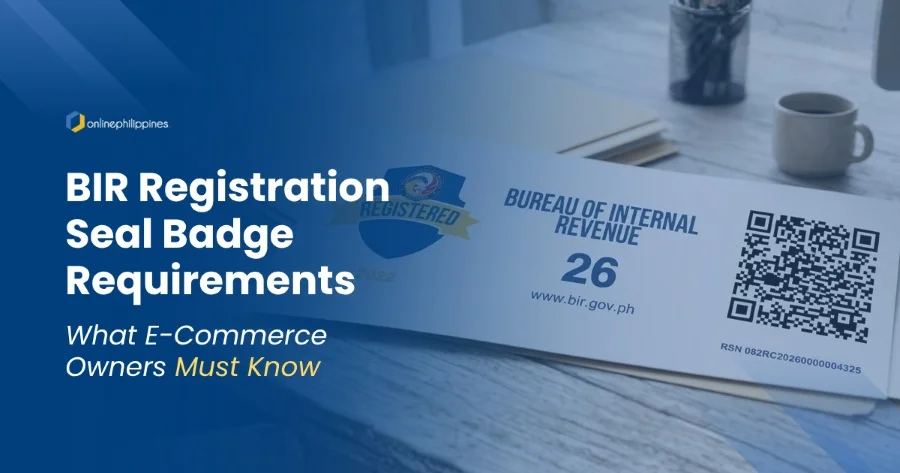
Revenue Memorandum Circular No. 38-2026, issued on April 29, 2026, addresses both problems. It requires online businesses to display a Registration Seal Badge, which serves as proof of registration and takes the place of the full COR or eCOR online. Each badge carries a QR code, so buyers and other parties can scan it and confirm that your registration is genuine and current through official channels. The badge protects your privacy while giving customers a quick way to check that you are the real thing.
For ecommerce owners, that makes the badge a trust signal as much as a legal obligation. Shoppers who worry about scams tend to reward stores that make verification easy.
Who Needs to Comply
The rule reaches further than many sellers expect. It covers online sellers and merchants, service providers with an online presence, and e-marketplace platforms. That includes the owner of a standalone Shopify or WooCommerce store, the seller who mainly uses Shopee, Lazada, or TikTok Shop, and the small brand taking orders through Facebook and Instagram.
It also reaches people who earn money online without selling a physical product. Bloggers, vloggers, live streamers, content creators, influencers, and anyone earning through online views, advertisements, affiliate commissions, or brand sponsorships are expected to display the badge in place of their COR. If your income flows through a digital channel, assume the rule applies to you unless a qualified tax professional tells you otherwise.
Being registered years ago does not exempt you either. Businesses with an older COR that has no QR code are not forced to replace it right away, but the BIR encourages them to update their records so they can obtain the badge. In practice, if you want to display the badge, an update to your registration is how you get it.
What Happens If You Do Not Comply
Marketplaces are treating this seriously. Shopee’s seller education page tells merchants to secure and display their badge as soon as possible to maintain active seller status and avoid disruption to their sales. It also states that non-compliance may bring BIR regulatory penalties of Php 1,000 per violation. Since a seller with several storefronts could rack up more than one violation, the cost of ignoring the rule can add up quickly, and the risk to your marketplace account may be worth even more than the fine.
This is where the BIR Badge Requirements become a business issue and not just a tax one. If your main sales channel is a marketplace that ties your seller status to compliance, a missing badge can interrupt revenue, hurt your ranking momentum, and force you into rushed fixes at a bad time. Sellers who sort this out early can plan calmly and keep growing. Trust signals do not stop at the BIR either, so it is also worth reading our guide on how to renew your DTI Trustmark to keep your store’s credibility current.
How to Get Your Badge
The good news is that the badge itself is free. The BIR issues it either through your Revenue District Office or online through the Online Registration and Update System (ORUS). The only cost involved is a Php 30.00 Documentary Stamp Tax on the certificate, paid online through the BIR’s ePayment channels. Keep your proof of payment.
The BIR has published a step-by-step taxpayer guide on how to generate the Registration Seal Badge in ORUS, and it is worth reading before you begin. You will need an ORUS account first, so enroll if you have not already.
For an existing business, Shopee’s guide describes a simple flow. After logging in to ORUS, go to your profile page and click the Synchronize button to update your registration records. Then open the Certificates and Permits section and download your latest COR with the QR code, which comes together with the Registration Seal Badge. Pay the Php 30.00 stamp tax when prompted, and you are ready to post the badge. If your records need corrections, the BIR guide also walks through the update process, where you choose your head office or branch, select the information to change, submit the application, and pay the same stamp tax.
New businesses take a slightly longer path because they must complete the registration form first. After submitting, they wait for Revenue District Office approval, which the BIR guide says takes up to three working days, then pay the stamp tax and generate their documents from the ORUS profile page. Have your business details and documents ready before you start so the process goes smoothly.
Where and How to Display the Badge
Getting the badge is only half the job. The badge needs to appear on your website, mobile app, online shop, and any e-commerce or marketplace profile page where you do business. If you sell on your own site, Shopee, and Facebook, expect to post it in all three places. Placing it in an easy-to-find section, such as an About page or a business information page, works far better than burying it in a footer link.
Only the badge should be posted, not the full COR. Shopee specifically advises sellers to crop just the badge with its QR code so sensitive information stays private. On Shopee, existing sellers can upload the badge through the Business Information page in Seller Centre, while new sellers can upload it during registration and onboarding.
Presentation matters too. Shopee notes that uploaded badge images are cropped to a 3:1 aspect ratio and shows a preview before you confirm. That means a badly prepared image can end up with the QR code cut off or shrunk. A blurry or clipped badge is hard to scan, which weakens the very trust it is meant to create. Preparing the image at the right proportions and resolution for each platform saves you from this problem.
What This Means for Your Website and Sales
Many owners treat compliance and conversion as separate topics, but they overlap here. A visible, scannable badge tells first-time visitors that your store is registered and accountable, which can ease hesitation at checkout, especially on higher-priced items or with buyers who have been burned before. Stores that look organized and transparent tend to earn repeat customers, and repeat customers are what make scaling possible.
Consider how the badge fits your site structure. A dedicated business information page can hold the badge alongside your registered business name and contact details, with links from your footer and About page. On product-heavy stores, a small mention near the trust section or checkout can reinforce confidence without cluttering the design. Technical details matter as well. The image should keep its QR code sharp on phones, load quickly, and sit somewhere both visitors and search engines can reach. If your theme or page builder limits where images can go, a professional website development team can build a proper home for it, and a well-planned e-commerce website makes future compliance updates much easier to manage.
Common Mistakes to Avoid
The most frequent error is posting the full COR instead of the badge. It may feel safer to show more, but it exposes information you do not need to share and goes against the guidance. Another mistake is assuming a marketplace profile is enough when you also run your own site, or the reverse. Each platform where you operate needs the badge.
Some sellers also forget to refresh their badge when their registration changes. If you add a branch, move, or change business details, your registration record changes too, and your displayed proof should stay current. Treat the badge as a living part of your online presence and not a one-time upload. Finally, do not assume small sellers are exempt. Casual sellers, live sellers, and social media merchants are all within the scope of the rule.
Don’t Let a Small Badge Slow Down Your Sales
The BIR Registration Seal Badge replaces the awkward habit of posting a full certificate, gives buyers a fast way to verify your business, and helps marketplaces and regulators identify who is selling legitimately. For honest sellers, that mostly means a higher bar for everyone and a stronger reason for customers to trust you.
Staying on the right side of this rule comes down to a few clear moves. Confirm that your business is covered, synchronize or update your registration in ORUS, pay the Php 30.00 stamp tax, download your COR with the badge, and display only the badge, clearly and legibly, on every platform you sell through. Keeping the BIR Badge Requirements in mind as you plan your next round of site updates will save you from last-minute scrambling and help your brand look as professional as it really is.
Displaying your badge is a strong first step, but it is only the beginning of building a store people want to buy from. Before a shopper adds anything to their cart, they are quietly asking whether your business is real, reliable, and worth their money. Proof of registration, a professional website, clear policies, and consistent branding all answer that question in your favor. Once that trust is in place, every peso you spend on marketing works harder, because people who trust you are far more likely to click, buy, and come back.
That is where Online Philippines comes in. We start with the foundation, from updating your website so your badge and other trust signals are properly placed, to building an e-commerce website that loads fast and turns visitors into buyers. From there, we help you bring in the right customers through search engine optimization, social media marketing, and Facebook and Instagram ads management, backed by branding and copywriting that make your store look and sound as credible as it really is. Compliance protects your business, and trust paired with smart marketing is what grows it.
If you want to be certain your online business is fully BIR compliant, work with us.
No Comments